The Public Value Test
What We Preserve, What We Build, and Who BenefitsGreenCap Civic Intelligence
Opening Perspective
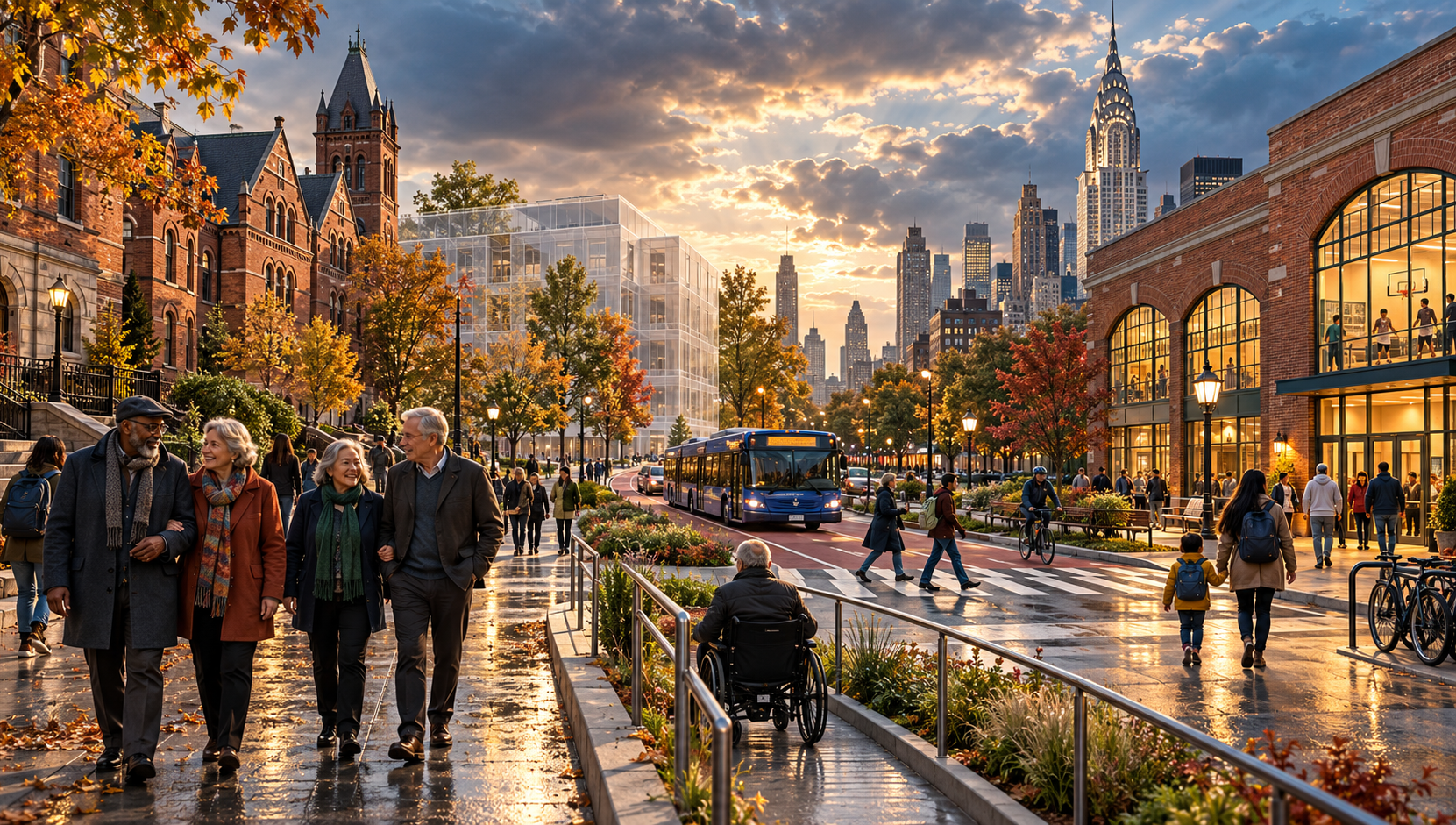
Redevelopment is not simply about changing the physical fabric of a place. It's a decision about which of the existing community's values we want to retain, what new opportunities we want to create and how we are going to assess the benefits that follow.
This week we have a proposed housing project on the former College of Saint Rose campus in Albany and a major preservation plan for the Chrysler Building in Manhattan as two very different approaches to dealing with old properties. We also have the Brooklyn bus priority improvements and the re-opening of a Queens recreation center as examples of how investments can improve people's everyday lives. The federal transit funding proposal raises the bigger issue of what the rules should be for the distribution of public funds.
These projects are quite different. You've got a prominent office building, an old college campus, a street area and a public recreation center each with their own set of constraints and opportunities. What they all have in common is the need to properly consider the cost, the options, the community requirements and the long-term outcomes.
This Week’s Redevelopment Signals
SIGNAL NO. 1|Albany’s Saint Rose Campus: Housing Opportunity and Preservation Trade-offs
THE SIGNAL: On Oct 8 the Albany County Pine Hills Land Authority announced it would commence negotiations with Jankow Cos. on a portion of the former College of Saint Rose campus. The proposal would be for approximately 160 units of housing for adults 55 and over in a 4 story complex. It is understood that as many as 17 of the existing campus buildings (including two of the former dorm complexes) could be torn down. The $2.5M figure reported is the amount of the property transaction, not the full cost of the housing. [1, 2]
What's changed is that the authority have now moved on to talks with a selected development team. That's a significant step, but it's not the same as project approval, completed financing or the go-ahead to demolish all the proposed buildings. [1, 2]
WHY IT MATTERS: Albany has a genuine interest in utilizing an underused campus and in meeting its housing needs. The prospect of demolishing the buildings however could mean the loss of historic features, the loss of salvageable materials and the loss of the character of the neighborhood. There are concerns about the state of the buildings and whether some of them could be re-used. Preservationists have raised questions about the proposed demolitions. (Restoration & Reuse — Historic Albany Foundation, n.d.) These views need to be properly weighed against each other rather than simply assuming that one of the two options (preservation or demolition) is always the correct one.
GREENCAP INSIGHT: A sensible redevelopment decision is one which explains not just what the new housing will deliver, but also why it is or is not possible to retain, alter or carefully remove the existing buildings.
SIGNAL NO. 2|Chrysler Building: Preservation as a Modernization Strategy
THE SIGNAL: On 7 October Tishman Speyer, The Cooper Union and investment partners announced a 150-year ground lease for the Chrysler Building in Manhattan. The deal is reportedly worth $235m and includes ongoing lease payments. The plan is to restore the building and upgrade the office space and building systems. The $235m is not to be read as a confirmed construction budget. [3]
WHAT'S CHANGED: There is now a long-term management and investment plan in place for the building. The focus has shifted from the rather murky question of ownership to a plan for repairs and a renewed business use of the building. The works under the plan have not yet started. [3]
WHY IT MATTERS: Historic buildings can remain economically viable when new investment is brought to bear to connect their design with the requirements of the present day. (Mayor, Governor, NYCEDC and Community Leaders unveil vision for redevelopment of Historic Kingsbridge Armory, $200 million investment in economic opportunities for Bronxites, 2023) The Chrysler Building's location, size and market are unique though and its financing approach is not in any way a model that can be simply applied to every other old industrial or institutional property.
GREENCAP INSIGHT: Preservation can be an economic proposition when the structure, the funding and the use all line up. The real question isn't whether every building can be saved, but whether reuse was properly considered prior to the decision to replace it.
THE SIGNAL: NYC has announced plans to reconfigure sections of Bay Parkway and Cropsey Ave in Brooklyn. The proposed changes are bus priority lanes, improved pedestrian ramps and 18 new median islands. The city states that approximately 35,000 people use this corridor each day (this is an estimated figure, not a measured outcome following the works). [4]
WHAT CHANGED: The project has moved from the planning stage to the stage of actual work commencing. The city is looking to address the problems of slow bus travel and safety on a street that is used by residents of Midwood, Bensonhurst and Bath Beach. [4]
WHY IT MATTERS: Transport investment does more than just reduce journey times. Reliable bus service and safer crossings can go a long way to helping people get to work, to school, to health care and to local businesses. The benefits should be measured in terms of actual journey times, safety and access post investment.
GREENCAP insight: a street is good infrastructure if it enables people to get to opportunities safely, reliably and affordably rather than just if it gets the car through it faster.
SIGNAL NO. 4|Queens Reopens Lost Battalion Hall After Public-Asset Renewal
THE SIGNAL: NYC announced the reopening of the Lost Battalion Hall Recreation Centre in Rego Park, Queens on October 9 after a $25.9m rebuild. The work has resulted in improved accessibility, entrances, restrooms, recreation spaces and building safety systems. [5]
WHAT'S CHANGED: This is a completed reopening rather than one which is still in the planning/design stage. Residents now have access to a state-of-the-art public facility as part of a long-established community resource. [5]
WHY IT MATTERS: Upgrading the infrastructure can keep services going while at the same time rectifying the backlog of repairs and access issues. The value of such an investment should be judged on how well the building works, how accessible it is, how many people use it and how it is maintained rather than simply by the quality of the opening ceremony.
GREENCAP INSIGHT: The best form of regeneration at times isn't about replacing a place. It's about taking a well-known public space and improving it so that it works better for the next generation.
SIGNAL NO. 5|Federal Transit Proposal Reopens the Debate Over Funding Criteria
THE SIGNAL: On 1 October the FTA released proposed changes to the Capital Investment Grants program rules. Some New Starts and Core Capacity projects could see an additional 10 percentage points in their federal share of the grant as a result of birth and marriage rates in the area. This is in accordance with the legal limits and other rules in place; it is not a simple 10% increase in the grant. Comments are due 16 November 2026. [6, 7]
WHAT'S CHANGED: The proposal is now open for public comment. It is not yet in force. The FTA state the intention is to speed up project delivery and improve accountability. The demographic rules do however raise some questions as to the potential impact on different communities. [6, 7]
WHY IT MATTERS: Transit projects are normally assessed on the basis of demand, cost, access, service and wider benefits. (MTA 2025-2044 20 Year Needs Assessment Comparative Evaluation, n.d.) Incorporating demographic factors means we have to explain how those factors relate to the outcomes we are looking at and consider the potential impact on different groups. That's the appropriate forum for presenting the evidence and for different views to be expressed.
GREENCAP INSIGHT: Funding rules are in essence decisions about public value. They can only be fair if the criteria are unambiguous, relevant and genuinely reflect who is going to benefit.
GreenCap Perspective Preservation, Replacement and the Burden of Proof
The Saint Rose and Chrysler Building stories are a useful contrast (not simply a demolition vs preservation contest). Albany's proposed senior housing will in fact meet a genuine community need. The Manhattan landmark restoration will in fact show that existing buildings can be of continuing use. All of it is subject to the constraints of money, the issues of safety and the uncertainty of the future outcome.
For GreenCap the disciplined decision process is to ask five questions: What value is there already? What are the risks and constraints to its continued use? What alternatives were considered and at what cost? What measurable public benefits will the preferred option deliver? And who will be ultimately responsible if those benefits don't materialize?
The same questions apply in relation to corridors beyond buildings. A corridor should be a safer, more reliable journey; a corridor should be a corridor that provides sustained public access to a recreation center; and a corridor funding rule should be one that is based on evidence, is fair and has real world consequences.
Demolition may at times be the only option. Preservation may at times be impossible. Neither of those should be a substitute for a clear and transparent comparison of the options.
Key Takeaways
- The Saint Rose proposal is in negotiations. The demolition and the housing outcomes are not yet final.
- The Chrysler Building agreement is a framework for preservation and modernization, not a finished restoration.
- Brooklyn's corridor project should be assessed in terms of actual service and safety improvements once it's been implemented.
- Queens' reopened recreation center is a case in point as to the public value of refurbishing an existing piece of civic infrastructure.
- Federal transit funding criteria are still proposed and open for public comment until November 16.
Looking Ahead
GreenCap will be monitoring the Saint Rose negotiations to see if we can get any clearer information on the building conditions, the reuse options, the affordability aspects and the public review process. We'll also be keeping an eye on the implementation milestones at the Chrysler Building, the performance measures on the Brooklyn bus corridor, the continued use of the Lost Battalion Hall and the federal comment process for the Capital Investment Grants.
The public value test isn't whether the project sounds revolutionary when it's announced. It's about whether the decisions are well justified and whether the end results are in fact worth the resources and the existing assets that have been put into it.
References
1. WAMC, October 8, 2026 — Saint Rose senior housing negotiations|https://www.wamc.org/news/2026-10-08/saint-rose-campus-demolition-senior-apartments
2. Times Union, October 8, 2026 — Jankow Cos. selected for campus negotiations|https://www.timesunion.com/news/article/land-authority-tout-plans-redevelop-chunk-saint-22468042.php
3. Tishman Speyer / Cooper Union, October 7, 2026 — Chrysler Building ground lease https://www.prnewswire.com/news-releases/tishman-speyer--the-cooper-union-finalize-ground-lease-agreement-and-revitalization-plan-for-chrysler-building-302901153.html
4. NYC Mayor’s Office, October 6, 2026 — Bay Parkway / Cropsey Avenue|https://www.nyc.gov/mayors-office/news/2026/10/fast-buses--mayor-mamdani-breaks-ground-on-new-bus-lanes-and-saf
5. NYC Mayor’s Office, October 9, 2026 — Lost Battalion Hall|https://www.nyc.gov/mayors-office/news/2026/10/mayor-mamdani-reopens-queens--lost-battalion-hall-following--25-
6. FTA, October 1, 2026 — Proposed CIG Policy Guidance|https://www.transit.dot.gov/funding/grants/grant-programs/capital-investments/2026-proposed-cig-policy-guidance-not-effective
7. Federal Register, October 1, 2026 — CIG guidance public notice|https://www.govinfo.gov/content/pkg/FR-2026-10-01/pdf/2026-20179.pdf
Editorial Statement
GreenCap’s Redevelopment & Infrastructure Watch translates public information, planning signals, and infrastructure developments into practical civic intelligence. The Signal and What Changed sections report sourced developments; Why It Matters and GreenCap Insight provide independent interpretation. Proposals and planned benefits are not presented as completed outcomes. GreenCap is independent, nonpartisan, and public-interest-driven.
Better Communities Begin with Better Intelligence.