From Public Promises to Measurable Results
Infrastructure involves not just the things that communities construct, but also the way they handle transitions and whether or not these transitions result in lasting public value.GreenCap Civic Intelligence
OPENING PERSPECTIVE
Infrastructure Is a Transition System
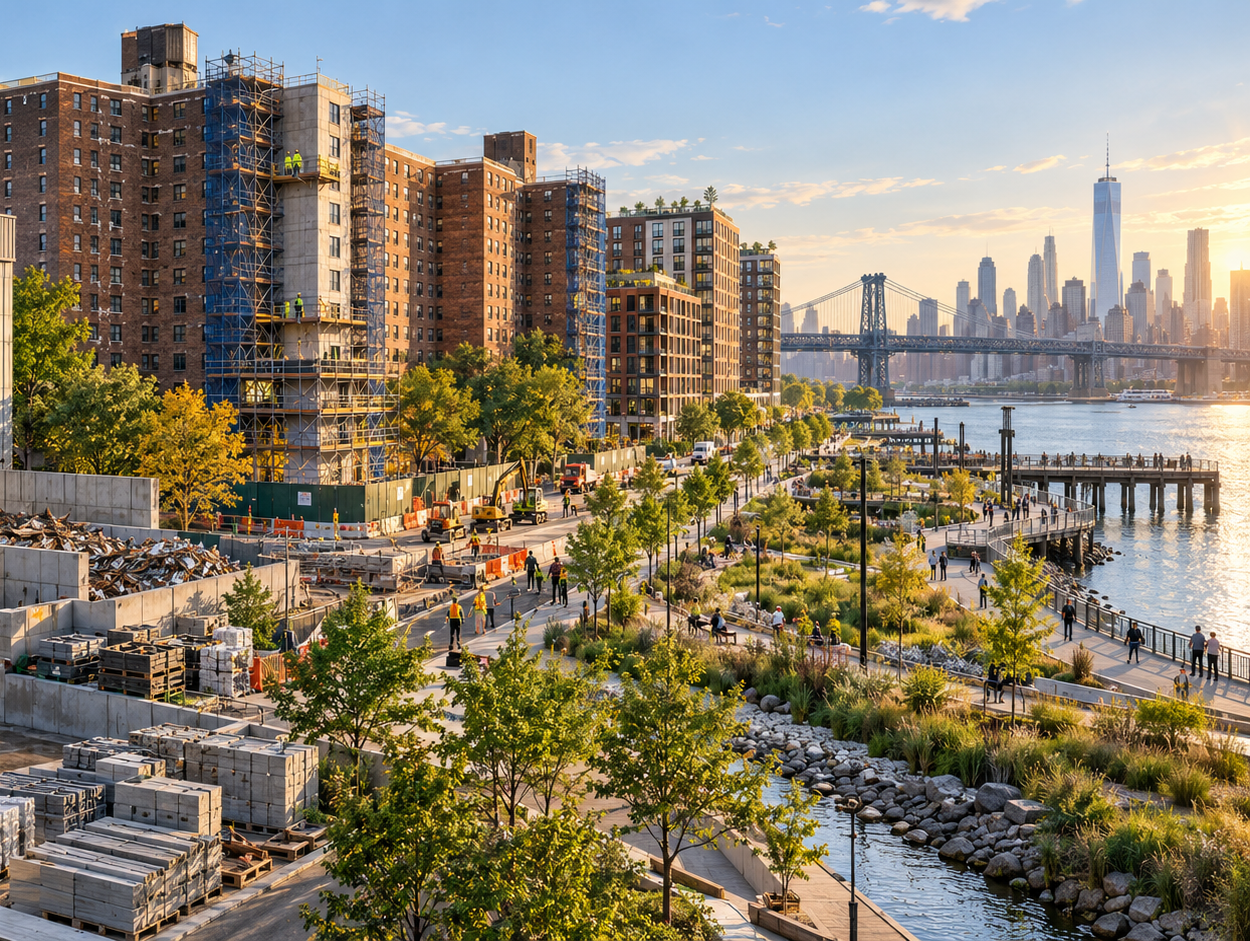
The recent developments illustrate the state of infrastructure at various stages of the public decision process. Albany needs to plan for when its landfill capacity is exhausted. New York City is speeding up the review of affordable housing in areas where there is already relatively little such housing while at the same time spending hundreds of millions of dollars to maintain its existing public housing. In Greenpoint, the waterfront park which was promised together with redevelopment more than twenty years ago is finally getting construction underway.
The main lesson is that it is not proper to judge success in infrastructure simply when the money is announced or when construction starts; instead, it should be assessed throughout the entire process, looking at what was already there, what had been promised, what had been kept or taken away, what had actually been delivered, who the beneficiaries were, and whether the public obtained lasting value.
This week, GreenCap will focus on turning transition points into durable, accountable public outcomes.
THIS WEEK’S REDEVELOPMENT SIGNALS
SIGNAL NO. 1
Albany Faces a Deadline on Its Waste Infrastructure
The SIGNAL states that Albany's Rapp Road landfill is approaching full capacity and will close by the fall of 2027. The city has assigned $12 million for the construction of a new transfer station of 26,000 square feet which will be located nearby, with the aim of having it in operation by September or October 2027. Construction is expected to start in January. The cost of closing the landfill, capping it and monitoring it is estimated to be an additional $10 million over a five-year period. (N.Y. Comp. Codes R. & Regs. Tit. 6 §§ 363-9.6 - post-closure care & custodial care, 2023) [1]
What has changed is that Albany is going from having a local disposal system to one that involves transfer and haul. Although residents are unlikely to notice any immediate changes in their curbside collection, the city will have to take the waste to other places for final disposal, which will lead to higher transportation and disposal costs.
WHY IT MATTERS The station is a response to an imminent capacity limit but does not deal with the bigger issue of how much material Albany sends into the waste stream or where it ends up. The change offers the chance to connect up the closing of landfills with improved recycling, greater diversion of organics, the recovery of construction materials, and regional waste planning.
A transfer station can deal with the problem of capacity right away without resolving the bigger waste issue. The next infrastructure strategy for Albany should focus on reducing the amount of material that becomes waste before then deciding how far that waste needs to be transported.
SIGNAL NO. 2
Affordable Housing Fast Track Targets New York City’s Lowest-Producing Districts
THE SIGNAL On October 1, New York City established 12 community districts as part of its Affordable Housing Fast Track. These districts account for about one-fifth of the city's 59 community districts yet accounted for only 883 of the 63,870 new affordable homes built over the past five years, that is, 1.1 per cent of the total number of affordable homes in the city. (NYHC Releases 2023 NYC Housing Tracker, 2023) From January 1, 2027 onwards, eligible affordable-housing rezoning proposals in those districts will be subject to a streamlined 90-day public review process, reducing the time by about four months as compared to the traditional ULURP. [2]
What has happened is that the city has gone from embracing the Fast Track idea to deciding specifically where it will be applied. This process keeps in place the reviews by the Community Boards and the Borough Presidents, public input, the environmental review requirements, and the protections for landmarks.
Why it matters is that the policy examines whether the development review process can be shortened without compromising the safeguards. It also establishes geographic accountability by directing the more rapid process to those communities which have the lowest rates of affordable housing production.
Faster reviews should lead to earlier certainty, not to less accountability. The true test of reform will be whether the shorter timeframes result in homes that are completed and permanently affordable.
SIGNAL NO. 3
Nostrand Houses Tests Preservation at Redevelopment Scale
The Signal states that on September 30, NYCHA, along with New York City and the Public Housing Preservation Trust, declared the $607 million comprehensive modernization program for the Nostrand Houses in Sheepshead Bay, Brooklyn, financially complete. The project involves the rehabilitation of 1,148 apartments in 16 residential buildings which house around 2,000 people. The work planned covers building systems, elevators, electrical wiring, accessibility, security, the interior of the apartments, and the remediation of lead and mold. (Michael, 2026) Construction is set to start this fall. [3]
What changed is that Nostrand Houses was the first project to achieve financial closure via the Public Housing Preservation Trust following the residents' vote in December 2023 to join. NYCHA will continue to have public ownership and responsibility for management, while the funding arrangement gives access to greater federal subsidies and extra financing capacity.
Why it matters This is about carrying out redevelopment by means of preservation rather than replacement. Rather than taking down housing and rebuilding entirely, the scheme makes use of substantial capital to extend the useful life of an existing public asset while at the same time ensuring that the residents keep their public-housing rights. The most sustainable housing asset might in fact be one that a community already has, provided that the government is able to obtain the capital, secure resident authority and have the necessary technical capabilities to make it safe, efficient and durable. (Mavani, 2026)
SIGNAL NO. 4
Greenpoint’s Box Street Park Moves from a 2005 Promise to Construction
THE SIGNAL On 1 October, New York City announced that work would begin on Box Street Park in Greenpoint, Brooklyn. The project, which covers an area of 2.5 acres, will turn the old parking lot into a public green space featuring an esplanade, terraced seating, dog runs, native plantings, a public restroom and links along Newtown Creek. The park had been promised as part of the neighborhood’s 2005 rezoning but had stayed unrealized for over two decades. [4]
What has changed is that a public amenity that has been available for years as part of a redevelopment commitment is now being delivered for the first time. The project is now serving as a test of whether public infrastructure, which has been delayed for so long, can finally keep up with the private development and the changes that have taken place in the neighborhoods.
Why it matters: Although private development can be achieved through rezoning, the public infrastructure will be carried out at a slower pace. The lengthy delays can damage people's trust and may leave expanding communities without the public benefits that were used as a justification for the action.
Public infrastructure must not be the final commitment made following redevelopment; it should be financed, scheduled, and monitored as an integral part of the redevelopment process from the beginning.
SIGNAL NO. 5
Albany’s Waste Transition Raises a Wider Question About Material Recovery
THE SIGNAL The fact that Rapp Road is about to be closed comes at a time when New York communities are still having to deal with the expenses of getting rid of construction debris, household waste and other kinds of material. The transfer station Albany proposes will maintain continuity of collection, but final disposal will still increasingly have to rely on facilities outside the city. [1]
The infrastructure problem has shifted from where Albany stores waste to how it is transported and managed. Because of this, the waste stream's makeup has become more important: each ton reused, recycled, or diverted means less need for facilities capable of long-distance disposal.
WHY IT MATTERS: Redevelopment and waste policy are closely connected. Buildings, infrastructure projects, and demolitions generate large material flows. Treating concrete, steel, fixtures, soil, and other materials only as debris can increase hauling, landfill demand, and emissions from replacement materials. (Sustainable Management of Construction and Demolition Materials, 2014)
A circular approach to redevelopment poses this question: before spending money on removing material, what can be recovered, reused or put back into use?
GREENCAP PERSPECTIVE
Measure the Transition, Not Just the Announcement
The major issue facing the public is not merely about beginning projects, but about managing the changes in a responsible manner. Albany needs to shift away from its reliance on landfills and establish a lasting waste management system. New York City should demonstrate that a quicker review process leads to the construction of housing, not just to faster approvals. The Nostrand Houses have to ensure that the financing goes towards long-term improvements which the residents can actually experience. Greenpoint must finally turn its decades-old promise regarding public space into a fully realized waterfront facility.
GreenCap believes the same standard should apply across redevelopment: define the existing asset or problem clearly, make the public promise measurable, preserve useful value where possible. A promise only attains public value when it has survived the process of moving from plan to delivery. The transition from planning to delivery is a matter of capacity, but the amounts of waste reduced and the level of material recovery will decide how much disposal infrastructure communities actually need.ru• The judgment of allowing reform should be based on the completion of housing and on the maintenance of existing safeguards, not just on how fast it is done. Preservation can be carried out on a scale associated with redevelopment provided that financing and resident governance are strong enough to renew the existing assets. The public amenities promised as a result of the rezoning should have schedules, financing and accountability no different from those of private development. In all infrastructure systems the key question is what measurable public value will remain once the transition is finished after the transition is complete.
LOOKING AHEAD
GreenCap will keep an eye on Albany's bidding process for the transfer station and its construction timetable, including the way the city deals with final disposal and its recycling strategy; the implementation of New York City's Affordable Housing Fast Track starting in January 2027; the first stage of construction at Nostrand Houses; and whether the long-delayed public benefits of Box Street Park are being delivered on schedule.
REFERENCES
1. Times Union, 4 October 2026: A transfer station is planned near the landfill in Albany, which is about to be closed. Source
On October 1, 2026, the Mamdani Administration has placed 12 neighborhoods on the fast track for affordable housing. Source: New York City Mayor’s Office
On September 30, 2026, the Mayor's Office of New York City announced with Mayor Mamdani that $607 million will be allocated towards the modernization of the Nostrand Houses in cooperation with NYCHA and the Public Housing Preservation Trust. Source
4. October 1, 2026, Mayor Mamdani's Office, New York City. The project for Box Street Park in Greenpoint, delayed for decades, is finally getting underway. Source
EDITORIAL STATEMENT
GreenCap’s Redevelopment & Infrastructure Watch translates public information, planning signals, and infrastructure developments into practical civic intelligence. GreenCap is independent, nonpartisan, and public-interest-driven. Better Communities Begin with Better Intelligence.