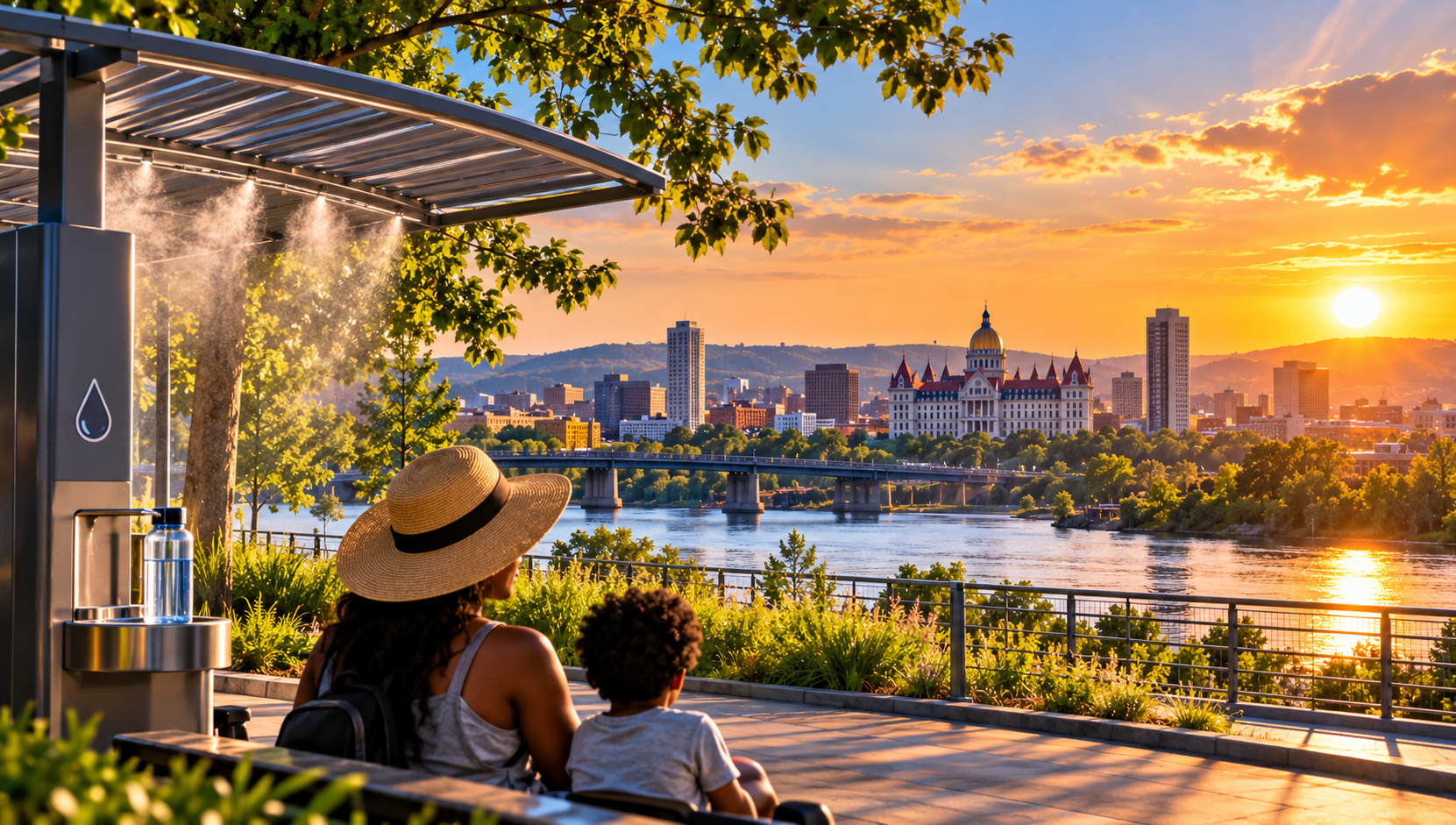
From Climate Warnings to Health Protection
Climate intelligence is most useful when it helps communities take preventive action to protect public health by ensuring they receive the necessary information and resources in a timely manner before problems arise.GreenCap Civic Intelligence
OPENING PERSPECTIVE
Recent warnings have become more specific. This week the World Meteorological Organization has revised its forecast to indicate that a stronger El Niño is likely. Experts have met to improve heat protection, and new advice outlines practical steps for safer public events. At the same time, wildfire smoke in Brazil showed how quickly environmental problems can disrupt everyday life. [1–5] All this shows that risk detection is only effective when it leads to better decision-making. (Riley, 2021) To build climate resilience, we need early warning systems, safer infrastructure, healthy public spaces, and health services that are prepared and have clearly defined responsibilities for taking early action. (Climate-Ready States & Cities Initiative, 2026) (Early Warning-Based Early Action Protocol Development Guidelines, 2026) What if each climate warning came with a specific, measurable plan to protect public health? (Climate and Health Strategic Framework, 2026)
THIS WEEK'S CLIMATE & HEALTH INTELLIGENCE 1 | A Stronger El Niño Extends the Window for Health Preparedness.
THE SIGNAL: On October 8, WMO reported that tropical Pacific sea-surface temperatures are forecast to rise to record levels during October–December 2026 as El Niño strengthens toward a projected December peak. WMO described a near-100% likelihood that the event would persist through February 2027. Its seasonal outlook points to higher temperatures across much of the world and changing rainfall patterns, with drought and flood risks varying by region. [1]
WHAT CHANGED: The latest monthly outlook sharpens the near-term warning and gives authorities additional lead time. A global seasonal forecast does not predict a particular storm, disease outbreak, or local outcome. (Lindsey et al., 2020)
WHY IT MATTERS: Heat, flooding, drought, water insecurity, disrupted food systems and some climate-sensitive diseases can place overlapping demands on health services. WHO's September public-health situation analysis provides a framework for assessing these risks by location and vulnerability. [6]
GREENCAP INSIGHT: A seasonal forecast becomes health intelligence when it identifies who may be exposed, which services could fail, and what agencies can do before conditions worsen.
2 | Global Heat Forum Puts Implementation at the Center THE SIGNAL:
The Global Heat Forum convened in Bangkok on October 6–9, bringing together researchers, public officials, and other practitioners on heat, health, and resilience. WMO identified the strengthening El Niño and associated extreme-heat concerns as prominent themes. [2]
WHAT CHANGED: The gathering created an international forum for sharing methods and solutions. Holding a forum does not, by itself, establish that cities have adopted new protections or that heat-related illness has declined.
WHY IT MATTERS: Heat protection requires practical coordination: identifying vulnerable neighborhoods, expanding cooling access, protecting outdoor workers, communicating warnings, and measuring whether interventions reach the people who need them. (Mallen et al., 2022)
GREENCAP INSIGHT: Heat resilience is not a single project. It is a coordinated public-health service delivered through buildings, streets, workplaces and local institutions. (Building Heat Resilient Communities: A Practical Framework, 2024)
3 | WHO Treats Heat Safety at Public Events as an Operational Duty
THE SIGNAL: The guidance issued on September 30 on this week's talks on heat aims to prevent and manage heat-related illness at large events. It emphasizes the need for safe drinking water, shade and cooling, scheduling, crowd control, workforce protection, surveillance, and access to properly prepared medical services. The WHO evidence review covered studies from 1980 through 2025. [3] A new feature of this guidance is that it applies existing evidence to develop a practical planning approach, rather than simply recording past events; the report states that well-organized on-site medical teams can care for most patients at such events, reducing strain on external emergency services.
WHY IT MATTERS: This matters because events like concerts, festivals, sports matches, and public celebrations increase the risk of heat exposure, especially for workers and people without access to water or shade. Effective health protection requires careful planning and proactive design before events. (Sa et al., 2021, pp. 438-441)
GREENCAP INSIGHT: Public gatherings can be safe only through solid infrastructure and thorough planning, not by giving out advice once the heat becomes dangerous. (Prevention and management of heat-related illness at mass gatherings: systematic reviews, 2026) (Prevention and management of heat-related illness at mass gatherings: systematic reviews, 2026)
4 | UNEP Shows How Cooling Can Begin With Building Design
On October 6, UNEP set out five strategies to reduce urban temperatures and the need for air conditioning: reflective roofs and walls, more outdoor shade, natural ventilation, the creation of green and blue spaces, and efficient, low-energy cooling systems. Instead of suggesting a one-size-fits-all solution, it focused on real-world examples and case studies. [4]
WHAT HAS CHANGED: The article presents cooling as an issue relating to design and land use, not just as something that can be achieved through buying an appliance. Some passive methods can reduce both indoor heat and energy consumption. However, their effectiveness varies by climate, building type, and maintenance. (Passive cooling for heat-resilient residential buildings: A systematic evidence map and climate-specific decision framework, 2026)
WHY IT MATTERS: In low-income areas and older buildings, the cost and availability of cooling can drive health inequalities. (Global Cooling Watch 2025, n.d.) GreenCap's redevelopment schemes should consider heat performance alongside housing quality, accessibility, and infrastructure costs from the start.
GREENCAP INSIGHT: Instead of waiting for emergencies, healthy redevelopment should start by designing roofs, streets, trees, and buildings to address daily heat exposure.
5 | Wildfire Smoke in Manaus Disrupts Schools and Public Services
THE SIGNAL: On October 9, the Associated Press reported that smoke from fires in the Brazilian state of Amazonas had greatly deteriorated air quality in Manaus, leading the city to suspend municipal work and halt public school classes while advising residents to take precautions. The report noted that pollutant levels averaged around 196 micrograms per cubic meter. However, this number does not reflect year-round conditions across the city. [5]
WHAT CHANGED: The situation shifted from an environmental issue to a direct disruption of schools and city services. While the report noted fire hotspots across the area, it did not link this event to the October El Niño forecast. This matters because wildfire smoke can affect people far from the fire. Students, clinic patients, workers, and people with respiratory or heart conditions need up-to-date air quality information and practical steps to protect themselves. GREENCAP INSIGHT: Air quality then ceases to be just an environmental matter and becomes a serious issue for public health and infrastructure. (Johnson et al., 2020, pp. 9804-9813) (Air Pollution, 2024)
SCIENTIFIC & POLICY OUTLOOK
Make Every Warning Actionable The plan provides a practical framework for being prepared for climate change. Forecasting agencies monitor changing conditions, health departments assess exposure and vulnerability, and local governments assess readiness for cooling, clean air, water, staffing, and communication. The biggest challenge is coordinating these actions before the next hazard hits. (About Building Resilience Against Climate Effects (BRACE) Framework, 2024) Decision-makers care not just whether a risk map is available, but whether it leads to funded actions, accountable organizations, and measurable outcomes. Comprehensive protection includes seasonal forecasting, heat planning, building design, and smoke response. (Keith & Meerow, 2022) (Hess et al., 2023, pp. 301-321) Turn Heat-Vulnerability Data Into Redevelopment Decisions The New York State Department of Health provides local authorities with its Heat and Health Profile Reports and information on heat vulnerability to support local planning. The reports include trends in the heat index, information on populations at greater risk, and details on adaptation resources. These are current state resources and not the result of a new initiative announced on October 9. [7] A practical step in connection with GreenCap's Capital Region redevelopment projects is to carry out heat and health assessments when evaluating sites. This involves identifying nearby vulnerable groups, examining shade, trees, and pavement, reviewing the building's cooling options, and considering access to transit, water, and other essential services. Although this helps to guide further investigation, it does not establish a direct link between a site and illness. (Adapting to Heat, 2012) The GreenCap application asks that, when preparing a site brief, you explain the property's economic potential and how its future use might reduce or increase environmental risks to neighboring residents.
KEY TAKEAWAYS • The WMO's improved forecast of El Niño provides early warning rather than definite details about the particular local effects. • The extent to which heat protection is effective depends on the coordination between the various public services, the planning of the event, and the design of normal places. • Passive and low-energy cooling may be used to supplement mechanical cooling. However, they cannot be guaranteed to be effective in all situations. • The smoke produced by wildfires can very quickly lead to disruptions in education, employment and health services even in areas that are not themselves affected by the fire. Decisions on the redevelopment of the Capital Region could better use existing New York heat-vulnerability data.
LOOKING AHEAD Track seasonal updates from the WMO, the Global Heat Forum's resulting actions, implementation of the WHO's guidance on heat events, and public health measures in response to major smoke events. Currently, GreenCap's top priority is to create a climate and health screening checklist for redevelopment sites that connects evidence of risk to practical actions and established thresholds.
EDITORIAL & EVIDENCE NOTE The report deadline is October 9, 2026, and the cited sources are those available in October, along with the earlier-mentioned guidance and established resources. The "Signal" and "What Changed" sections summarize the information provided by the sources; the "Why It Matters," "GreenCap Insight," and the Capital Region's recommendations reflect GreenCap's own analysis. Since a seasonal forecast is probabilistic, it cannot predict what will happen at any specific location. This publication is meant as a tool for civic education and must not be considered as medical advice. The GreenCap Civic Intelligence Institute is independent and nonpartisan, promoting the public interest; better communities can start by improving their intelligence.
References
(2024). Climate and Health Resources. CDC. https://www.cdc.gov/climate-health/php/resources/index.html
Riley, R. E. (2021). An Evaluation of the Utility of a Decision-Maker-Driven Climate Hazard Assessment Tool. Weather. https://doi.org/10.1175/wcas-d-20-0019.1
(2026). Climate-Ready States & Cities Initiative. Centers for Disease Control and Prevention. https://www.cdc.gov/climate-health/php/climate_ready/index.html
(2026). Climate and Health Strategic Framework. Centers for Disease Control and Prevention. https://www.cdc.gov/climate-health/php/about/strategic-framework.html
Lindsey, R., Halpert, M., Gottschalk, J., & Rosencrans, M. (May 30, 2020). Understanding NOAA's monthly and seasonal climate outlooks. NOAA Climate.gov. https://www.climate.gov/news-features/understanding-climate/understanding-noaas-monthly-and-seasonal-climate-outlooks
Mallen, E., Roach, M., Fox, L., Gillespie, E., Watkins, L., Hondula, D. M., Vaidyanathan, A., Manangan, A., Perkins, A. N. & Schramm, P. J. (2022). Extreme Heat Exposure: Access and Barriers to Cooling Centers — Maricopa and Yuma Counties, Arizona, 2010–2020. MMWR 71(24). https://doi.org/10.15585/mmwr.mm7124a1
(2024). Building Heat Resilient Communities: A Practical Framework. https://doi.org/10.13140/RG.2.2.36504.89604
(2026). Prevention and management of heat-related illness at mass gatherings: systematic reviews. World Health Organization. https://www.who.int/publications/i/item/B09849
Johnson, S., Haney, J., Cairone, L., Huskey, C., & Kheirbek, I. (2020). Assessing Air Quality and Public Health Benefits of New York City's Climate Action Plans. Environmental Science & Technology 54(16), pp. 9804-9813. https://doi.org/10.1021/acs.est.0c00694
(2024). About Building Resilience Against Climate Effects (BRACE) Framework. Centers for Disease Control and Prevention. https://www.cdc.gov/climate-health/php/brace/index.html
Keith, L. & Meerow, S. (2022). PAS Report 600: Planning for Urban Heat Resilience. American Planning Association. https://www.researchgate.net/publication/359830704_PAS_Report_600_Planning_for_Urban_Heat_Resilience
(2012). Adapting to Heat. U.S. Environmental Protection Agency. https://www.epa.gov/heatislands/adapting-heat