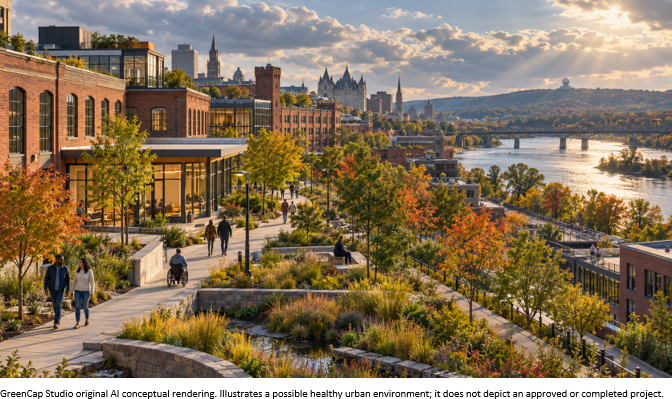
Local Decisions That Protect Health
Climate intelligence matters most when it leads to real changes in people's daily lives and the services they rely on.GreenCap Civic Intelligence
Opening Perspective
Forecasts can highlight potential dangers, but communities decide how to use that Information. This issue shares new advice on weather monitoring, research on mosquito-borne diseases, a review of municipal codes, and examples of city health initiatives. The main question is practical: do local rules, public services, and neighborhood conditions help keep people safer?
Here are four new updates, focusing on New York and the Capital Region, with developments through October 2, 2026.
This Week's Climate and Health Intelligence
1 Protecting the Signals Behind Weather Warnings
On September 28, the International Telecommunication Union and the World Meteorological Organization issued a joint handbook. They urged protection of the radio frequencies used for weather forecasting, early warnings, climate monitoring, and water management. Interference reduces the accuracy and availability of environmental observations, and some satellite instruments rely on specific frequencies to detect very weak natural signals. [1]
The agencies provided updated technical and regulatory guidance at their seminar in Geneva from September 28 to 30. This is a new policy and operational resource, not a final expansion of warning coverage.
GreenCap sees health preparedness as largely depending on behind-the-scenes infrastructure. Reliable observations help authorities anticipate hazards and organize protective actions. Keeping these systems strong helps protect the public.
GreenCap Insight: Information that triggers a warning deserves as much care as the systems that deliver it.
2 Mosquito Prevention Needs More Than a Climate Forecast
A review announced by Monash University on October 2 and published in Science Advances examines the ecological, epidemiological, and socioeconomic factors that affect malaria and dengue transmission and recommends coordinated prevention measures, such as vector control, vaccine deployment, and emissions reductions to minimize warming.[2]
The review now examines climate and non-climate factors together in the prevention section. This strengthens the case for studying disease patterns alongside local conditions and control efforts.
A warmer climate alone doesn't tell a community how many infections to expect. Disease-specific surveillance, environmental management, and prevention methods are still essential. This global review does not predict outbreaks for Albany or New York.
Climate information is most useful when health agencies connect it to conditions they can actually change.
3 Municipal Rules May Lag Behind Local Risks
The Signal: In a preprint published on September 28, Arianna Salazar-Miranda examined 3.6 million sentences from the municipal codes of 204 U.S. cities and compared hazard-related provisions with those in FEMA's National Risk Index. The study shows that emergency management receives more regulatory attention than prevention, with land use the smallest regulatory category. Flooding makes up 61% of the hazard-related text, as against 9% of the average city's assessed risk. [3]
What's new? The study offers a new way to compare city regulations with the hazards they face. The findings are still early, since the source is a preprint and the code doesn't cover enforcement, investment, or overall preparedness.
For GreenCap, it's important to check if development standards and planning decisions consider local risks before emergencies happen. However, the findings don't show that Albany's codes are lacking or that every city should devote the same attention to each hazard.
GreenCap Insight is most useful when local decisions are based on its findings.
4 Healthy Cities Connect Local Data With Public Action
At the Alliance for Healthy Cities conference in Sydney on September 28, the World Health Organization acknowledged eight cities and one national forum. Baguio City in the Philippines received recognition based on a Livability Index, which included all 128 villages and was incorporated into planning and budgeting. Madiun City in Indonesia was recognized for community environmental management, which addressed flooding and climate resilience. The WHO states that its program has reduced flooding in vulnerable areas, cases of diarrhoeal disease, and instances of dengue fever. [4]
The awards focus on current local practices rather than introducing new initiatives. They show how local evidence and community participation shape public decisions.
The lesson suggests that redevelopment schemes should be evaluated by the conditions they provide for residents, such as environmental exposure and access to services. Yet the WHO report on Madiun does not contain effect sizes, nor does it prove that similar results would occur elsewhere.
According to GreenCap Insight, healthier cities use local knowledge when deciding how to distribute resources.
Scientific and Policy Outlook
Making Local Decisions More Protective
The examples do raise an important question for climate and health policy—can organizations convert evidence into actual action? For weather monitoring to be effective, it needs reliable observations. To prevent mosquito-borne diseases, communities need to conduct surveillance and implement coordinated control measures. Municipal rules should account for local hazards, and neighborhood data should have clear ownership, funding, and a role in decision-making.
GreenCap thinks the next phase of local resilience should link these responsibilities. The maps should not just indicate exposure but also show who can take action, what actions are feasible, and how to monitor progress. When evaluating programs, assess how effectively they protect people, with particular attention to those with fewer resources.
New York and Capital Region Spotlight
Carry Seasonal Prevention Into Autumn
The health advisory published by New York on August 26 has told people to take precautions with respect to the West Nile virus and eastern equine encephalitis; this is continued advice and should not be regarded as a new statement on the subject. Similarly, the advisory issued by Onondaga County on August 20 also emphasized the importance of taking mosquito-bite precautions throughout the summer and fall until the first frost. [5, 6]
GreenCap suggests that the communities in the Capital Region combine local health advisories with the routine maintenance of buildings, drainage systems, and outdoor areas. Development teams should consider how their designs handle standing water, create attractive public spaces, and ensure access to essential services. However, this is only a planning recommendation and does not mean any particular site is causing disease or that green infrastructure increases mosquito risk.
Key Takeaways
Reliable climate observations help safeguard the public; to prevent disease, it is necessary to consider both local conditions and climate. While municipal code reviews can point out problems, the text by itself does not show that preparations have been made. Neighborhood evidence is most valuable when it influences budgets and services.
Looking Ahead
Watch for new guidance on the spectrum, independent reviews of the municipal code findings, and local evidence on the health benefits of environmental programs. For GreenCap's redevelopment efforts, the next stage involves including specific health and climate questions in site assessments and monitoring how these questions affect project decisions.
References
On September 28, 2026, the ITU and the WMO asked that the radio spectrum be kept for use in weather, climate and water services.
On October 2, 2026, Monash University issued a research announcement via EurekAlert about the need for a solution to mosquito-borne diseases as climate change intensifies.
Related research: The different developmental pathways of malaria and dengue in response to climate change. Science Advances. DOI 10.1126/sciadv.aei0953.
[3] A. Salazar-Miranda, 28th of September 2026. What Do City Codes Say Regarding Climate Risk. arXiv 2609.36191, version 1. Preprint.
The World Health Organization, on September 28, 2026, acknowledged several healthy and innovative cities in the Western Pacific Region.
On August 26, 2026, the New York State Department of Health advised New Yorkers to take precautions against the West Nile virus and stated that additional guidance is available.
On August 20, 2026, the Onondaga County Health Department announced the first case of West Nile virus in a human that season and said seasonal advice is ongoing.
Evidence and Editorial Notes
The sources were checked on October 3, 2026, for the October 2 edition. The mosquito signal is based on the university's research announcement, but we could not obtain the full journal text for review. The municipal-code signal is based on the abstract of the posted preprint. The WHO examples come from institutional reports, not independent causal evaluations. The earlier advisories issued by New York provide the required background context.
The Information in The Signal and What Changed comes from various sources; the sections titled Why It Matters, GreenCap Insight, and the local recommendations reflect GreenCap's interpretation of the situation, while The Brief is intended to foster public education and a better understanding of civic issues.
GreenCap Civic Intelligence Institute
Better Communities Begin with Better Intelligence.