GreenCap Civic Intelligence
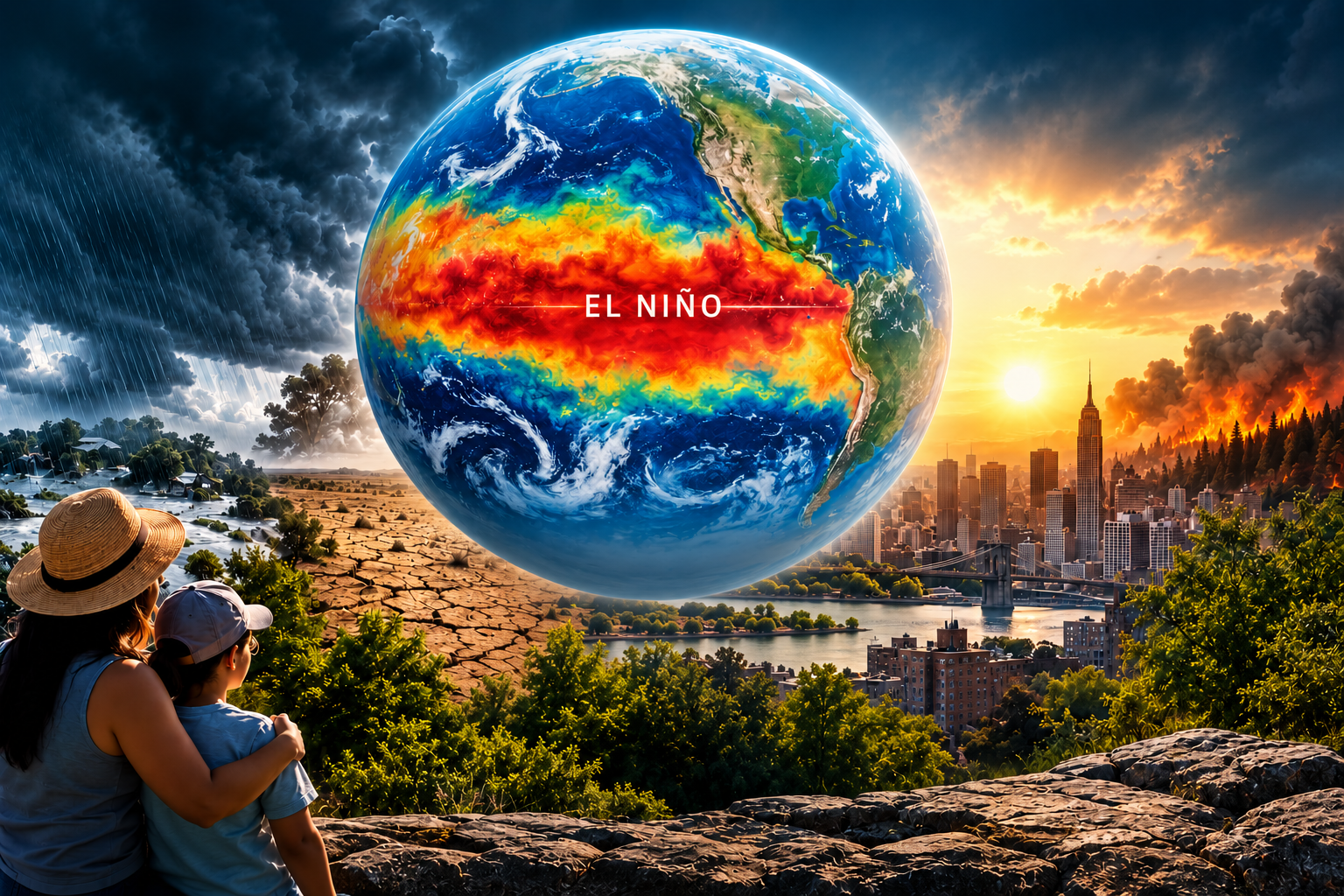
A Forecast Means Time to Get Ready The World Meteorological Organization says El Niño is already happening and will likely get stronger, with these conditions expected to last until February 2027. The effects will vary by region, but the main idea is simple: better forecasts give communities valuable time to prepare. As climate science spots risks sooner, the question is: What kinds of harm can communities avoid if they know about certain climate risks ahead of time?Green-cap
THIS WEEK'S CLIMATE & HEALTH INTELLIGENCE
Intelligence No. 1
A Very Strong El Niño Is Becoming a Preparedness Test
The Signal
The World Meteorological Organization stated on September 3 that El Niño had become firmly established and was expected to strengthen considerably in the coming months.
WMO forecasts indicate nearly a 100 percent probability that El Niño conditions will persist into February 2027.
Currently, ocean temperatures are warm. The Niño 3.4 index was between 2.2°C and 2.6°C above average in weekly measurements from late July to mid-August. According to the World Meteorological Organization's seasonal modeling, the ensemble mean anomaly is expected to be about 3.6°C from September through November, with the peak intensification anticipated in November and December.
Why It Matters
El Niño is one of the world's most influential natural climate patterns, and a strong event can significantly affect rainfall, temperature, and atmospheric circulation.
Effects differ from place to place because geography and season, along with other ocean and atmospheric conditions, determine how El Niño affects different areas.
That distinction is important.
A global climate signal should not be seen as a prediction of a specific local disaster; instead, it warns governments and communities that climate risks are evolving.
GreenCap Perspective
Public value is created when predictive insights are turned into specific preparedness actions.
The strength of modern climate science should be evaluated not only by the accuracy of its predictions but also by how early institutions act on that information to protect people.
Intelligence No. 2
Climate Hazards Cannot Be Managed One at a Time
The Signal
El Niño shows that a change in one part of the climate system can affect conditions thousands of miles away.
Meanwhile, drought, wildfire, smoke, water stress, and other environmental pressures can enhance the impact of extreme heat.
These factors can intensify one another's effects.
Why It Matters
Nearly always, communities face climate risks on their own.
Drought raises the risk of wildfires. Wildfires result in hazardous smoke. Higher temperatures increase electricity demand and strain infrastructure. Flooding interferes with transportation, housing, healthcare, and water systems.
The situation can quickly shift from an environmental incident to one that threatens public health, infrastructure, and the economy; consequently, resilience planning ought to adopt a systems-based approach rather than focusing only on individual hazards.
GreenCap Perspective
A variety of linked strategies will shape the future of climate change preparedness.
Communities should consider not only which hazards require preparation
but also examine:
Could any other systems or sectors be affected by this hazard?
The question might reveal vulnerabilities that conventional emergency planning tends to overlook.
Intelligence No. 3
New York Is Turning Heat Data Into Local Intelligence
The Signal
New York State shows how climate information can support local decision-making.
The New York State Department of Health's Heat Vulnerability Index enables public health officials, residents, and other stakeholders to identify communities outside New York City with populations more vulnerable to extreme heat.
The index includes 14 indicators related to heat exposure, sociodemographic conditions, and health outcomes.
The state also provides a Heat Risk and Illness Dashboard, which enables communities to understand the relationship between temperature and heat-related illness.
Why It Matters
Extreme heat affects neighborhoods differently.
Several factors can influence vulnerability, including age, health, housing quality, access to air conditioning, transportation options, language barriers, and more.
Public agencies can determine which locations most need cooling centers, where transportation help is necessary, and where specific communication or other interventions could reduce risk; that is precisely what is taking place.
Civic intelligence is what determines which interventions should come first.
That distinction matters more as communities face scarce resources and rising climate risks.
SCIENTIFIC & POLICY OUTLOOK
From Early Warning to Early Action
El Niñois development signals a significant shift in climate policy.
Scientists can identify some climate conditions weeks or months before their full effects become evident.
The latest WMO forecasts show that seasonal prediction models agree unusually strongly that El Niño will continue into early 2027.
This situation presents an opportunity for anticipatory governance.
Public-health authorities can concentrate on vulnerable groups. Emergency managers can assess their response capacity. Infrastructure agencies can identify the critical systems. Water managers can assess pressure on the supply. Agricultural organizations can prepare farmers for changing conditions.
We are not trying to guess every local outcome exactly.
The objective is to use reliable information as quickly as possible to improve decision-making.
COMMUNITY RESILIENCE SPOTLIGHT
New York's Heat Vulnerability Index
New York's Heat Vulnerability Index is a real example of climate data used as a planning tool.
The index uses a climate vulnerability framework that includes exposure, sensitivity, and adaptive capacity, and applies 14 indicators to identify areas with large populations at risk from heat.
The tool ought to go beyond merely describing risk.
It can help inform decisions about cooling centers, transportation access, multilingual communication, and the services high-risk groups need, such as older adults who live alone.
This represents an important principle for local climate adaptation:
Better information not only describes a problem but also helps communities decide what to do next.
GREENCAP PERSPECTIVE
The Next Frontier Is Acting Earlier
For many years, attention in climate policy has focused on two things: curbing future climate change and handling disasters when they occur.
A third capability is becoming increasingly important:
Performing during the time interval that lies between the issuance of the forecast and the moment of impact.
A trustworthy forecast provides governments and communities with time. A trustworthy forecast provides governments and communities with time.
Now is the time to identify vulnerable neighborhoods. Now is the time to prepare health systems. It is time to inspect the infrastructure. Now is the time to contact residents. It is now time to coordinate the various institutions.
We must distribute our resources now, before the situation turns into an emergency. How El Niño develops will show whether advances in climate science can be turned into practical preparedness measures. We cannot avoid all climate hazards; we are already detecting some of them. The question is no longer just 'What will happen?' but 'What existing knowledge will be put to use to guide action?'
KEY TAKEAWAYS
El Niño is expected to be firmly established and to strengthen, with the WMO stating there is nearly a 100 percent chance the phenomenon will last until February 2027.
Although the effects will vary considerably from one place and one season to another, a strong El Niño raises the possibility of major changes in rainfall and temperature patterns.
The key point in this situation extends far beyond El Niño. Today, climate-related hazards interact with health, economic, and social systems, as well as infrastructure. Because of this, effective resilience requires institutions to understand the connections among them rather than addressing them separately.
The heat-health resources available in New York show how environmental data can be transformed into civic intelligence so decision-makers can identify vulnerable communities and direct interventions more strategically.
Improved forecasting creates an increasing opportunity by providing additional lead time and enabling more informed decision-making.
LOOKING AHEAD
GreenCap will monitor the development of El Niño and any new evidence on its regional effects, with a particular focus on public health, infrastructure, and community resilience.
As predictions become more accurate, the main signs of progress will go beyond simply gaining knowledge about climate risk.
How communities put that knowledge into practice will determine whether they experience negative consequences.
REFERENCES
The World Meteorological Organization stated on September 3, 2026, that El Niño is expected to become very strong and will therefore increase the risks of extreme weather in 2027.
World Meteorological Organization. (2026, September 3). El Niño/La Niña Update. August 2026.
Global Seasonal Climate Update for September–October–November 2026. World Meteorological Organization. (2026, September 3).
Heat Vulnerability Index, revised in July 2026, New York State Department of Health.
Heat risk and illness dashboard prepared by the New York State Department of Health in 2026.
Seasonal Outlook from the Climate Prediction Center, National Oceanic and Atmospheric Administration (2026).
EDITORIAL STATEMENT
GreenCap believes communities can improve only when people have better information.
The Climate & Health Brief produced by GreenCap Civic Intelligence takes the most recent climate, environmental, and public-health information and turns it into intelligible insights for communities, professionals, and decision-makers.
GreenCap Civic Intelligence Institute
Easy for everyone to understand, credible for experts, and useful for decision-makers.