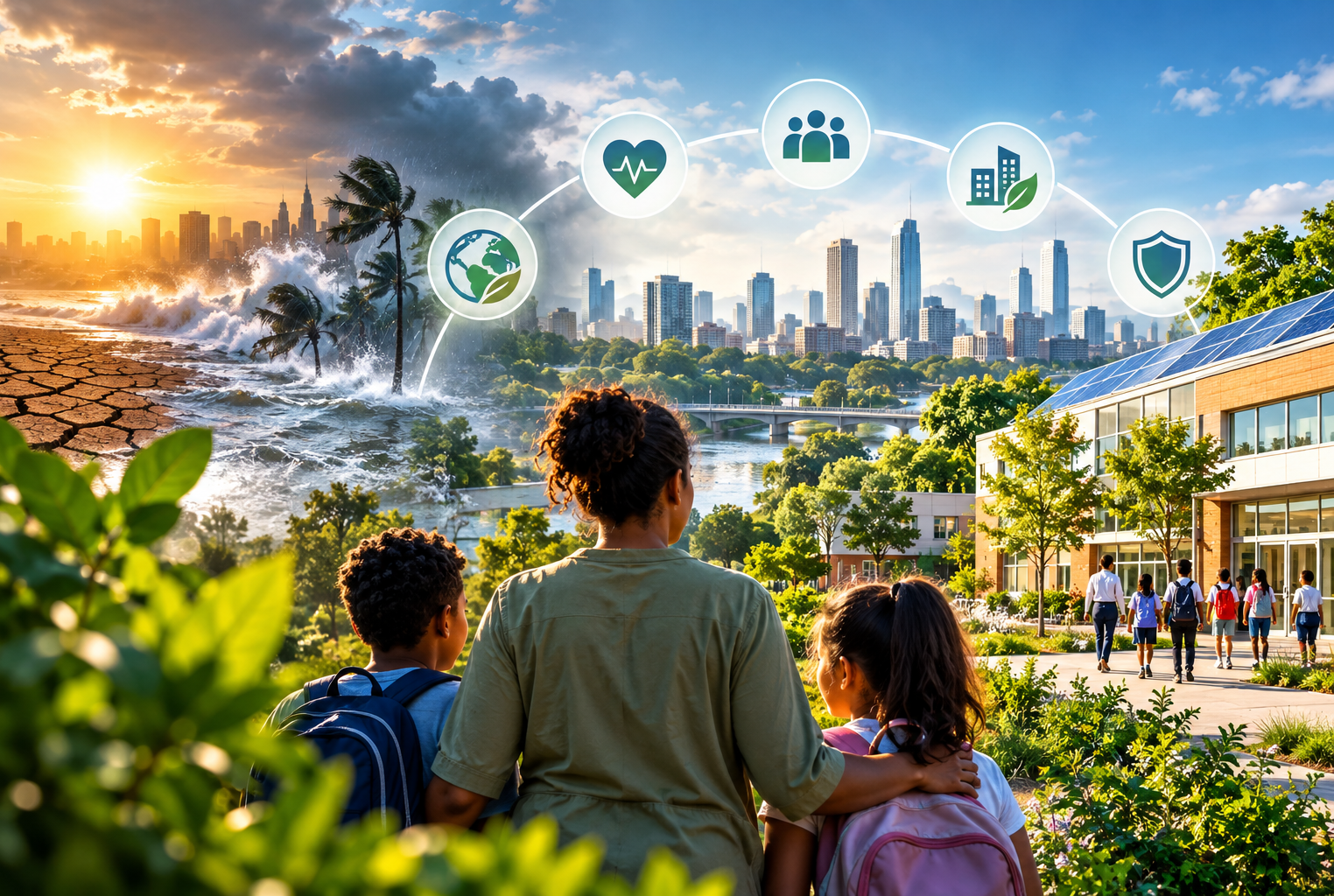
PREPAREDNESS IS BECOMING PART OF EVERYDAY INFRASTRUCTURE
Climate resilience is possible only when information, funding, public health services, and everyday institutions are ready before the next emergency happens. This week, we will cover topics like planetary boundaries, climate investment in New York, early-warning finance, climate and health planning in the Caribbean, and global pandemic preparedness.GreenCap Civic Intelligence
Opening Thesis
Climate and public-health resilience are increasingly converging around one practical idea: preparedness must be built before the emergency. This week’s developments range from Earth-system science to school air quality, early-warning finance, regional health planning and pandemic governance. Together, they show that resilience is not a single project. It is the capacity of institutions to anticipate risk, protect people and continue functioning when pressure arrives.
The strongest resilience systems do not begin with the emergency. They begin with the decisions made before it.
This Week’s Climate & Health Intelligence
1 | Seven of Nine Planetary Boundaries Have Now Been Breached
On September 21 the Potsdam Institute for Climate Impact Research issued its 2026 Planetary Health Check. This assessment shows that seven of the nine planetary boundaries have been crossed and that all seven are showing a trend of increasing pressure. The boundaries in question are climate change, biosphere integrity, land-system change, freshwater change, biogeochemical flows, novel entities and ocean acidification. [1]
WHY IT MATTERS
The fact has important implications for public health since climate conditions, water supplies, ecosystems, pollution and food systems do not function on their own. Pressure on one system can increase the risks in another, and when ecosystems are degraded together with social vulnerability the effects of extreme events can be made worse. (Lynn et al., 2011)
GREENCAP INSIGHT
Public health consists of more than just health care and also relies on the stability of the environmental systems which enable healthy communities.
2 | New York Connects Climate Investment with Health and Affordability
On the 22nd of September New York stated its intention to release nearly one billion dollars as part of a second phase of its Sustainable Future Program. This amount comprises 500 million dollars for the decarbonization of buildings and for cutting energy costs, including 50 million dollars for the Clean Green Schools Program which is aimed at improving the facilities of under-resourced schools, reducing emissions and enhancing indoor air quality. The package also contains 300 million dollars for renewable energy and further investments in sustainable infrastructure. [2]
WHY IT MATTERS
It is a significant link between climate and health. Buildings have an impact that goes beyond energy use; they affect indoor air quality, thermal comfort, household expenses and people's exposure to heat or cold. (Sherman et al., n.d.) Schools are particularly important since both children and staff spend a great deal of each day within them. (Healthy Schools, 2024)
GREENCAP INSIGHT
Public value is greater when a given amount of money leads to improved environmental performance, health, and affordability at the same time.
3 | Early Warning Is Being Treated as Core Adaptation Infrastructure
This week the World Meteorological Organization has once again been calling for funding at every stage of the early-warning process: for observations, research, the exchange of data, forecasting, communication and the ability to take action. The WMO points out that countries which have comprehensive early-warning systems suffer considerably less disaster-related death and refers to early warnings as "adaptation in action". [3]
WHY IT MATTERS
A warning can only be effective if people get it in time, understand its meaning and the institutions are ready to take action; this involves having sensors, making forecasts and ensuring communication, as well as having trustworthy messengers, emergency procedures, transportation services, health services and existing local capacity. (Early warning alert and response (EWAR) in emergencies: an operational guide, n.d.)
GREENCAP INSIGHT
The risk is identified by climate intelligence, and resilience starts at the point when institutions take timely action on that intelligence.
4 | The Caribbean Adopts a Regional Climate-and-Health Action Plan
On 25th September the health ministers of CARICOM approved the Caribbean Action Plan on Health and Climate Change 2026–2031, the plan having been developed with the support of PAHO/WHO. The framework aims at enhancing resilient and sustainable health systems as the Caribbean nations come to face hurricanes, extreme heat, flooding, drought and changing patterns of vector-borne disease. [4]
WHY IT MATTERS
The plan shows a change within the institution since climate hazards are no longer seen merely as environmental or emergency-management issues; instead, they are increasingly included in ordinary health-system planning, financing and preparedness.
GREENCAP INSIGHT
Climate resilience is more durable when it is incorporated into regular health-system planning rather than being put into action only after a disaster occurs.
5 | World Leaders Renew Pandemic Preparedness Commitments
On 25 September the second High-Level Meeting of the United Nations General Assembly on Pandemic Prevention, Preparedness and Response took place, at which governments recommitted themselves to sustained and more equitable investment in this area, drawing on the lessons from COVID-19 and the recent reforms to international health cooperation. [5]
WHY IT MATTERS
Pandemics and climate hazards are different kinds of threats, but they reveal a similar flaw in institutions—that is, systems which wait until crisis conditions arise have to react under greater pressure and at a higher social cost. (Paniagua & Rayamajhee, 2021, pp. 537-552) The ability to be prepared must exist before there is a sudden increase in demand.
GREENCAP INSIGHT
One cannot indefinitely make up things on the spot; resilience is the capacity that is developed in advance to enable essential systems to keep on working when changes in conditions occur.
Scientific & Policy Outlook
From Risk Information to Protective Capacity
The thing that is common to all the signals this week is the gap between knowing and taking action. It is possible for scientists to identify the increasing pressure on the Earth system, for meteorological agencies to predict hazards, for governments to map out communities that are vulnerable, and for public-health agencies to determine the likely health effects. Yet having this information does not in itself protect people. (Culli, 2025)
Protection is achieved when that knowledge is put into action through investment, infrastructure, institutions, and well-defined responsibilities. (OECD Review on Aligning Finance with Climate Goals 2026, n.d.) For example, a school with cleaner indoor air, a health system ready to deal with diseases that are sensitive to climate, or an early-warning system linked to the local ability to respond all turn information into protection.
The next stage in developing resilience goes beyond just improving forecasting; it is about ensuring that institutions can take action on what the forecasts indicate.
Community Resilience Spotlight | Healthy Schools as Climate Infrastructure
The $50 million investment planned by New York for its Clean Green Schools serves as a practical illustration of how climate and health policy are coming together in a typical public institution. By improving school buildings, emissions can be reduced together with better indoor air quality and the facilities can also be made more capable of protecting students and staff in the light of changing environmental conditions. [2]
The main lesson does not end with schools; libraries, transit stations, housing, clinics, community centers and other common places can also form part of a distributed resilience network if their design takes into account heat, air quality, energy reliability and other climate-related risks. (Keith & Meerow, 2022)
The locations that people use every day can form the first level of protection against the conditions that communities now have to face.
Key Takeaways
- Seven out of the nine planetary boundaries are now believed to have been exceeded, which underlines the interconnectedness of environmental and health risks.
- The state of New York is linking investments in the climate with indoor air quality, affordability, and building performance.
- Financing is needed at every stage of the early-warning system, from observation through to action.
- The climate resilience of Caribbean governments is being incorporated into regional health planning.
- The talks about preparing for a global pandemic serve to underline a more general truth, that resilience can only be achieved through having built up the necessary capacity in advance.
Looking Ahead
The policy issue is now becoming more evident in that communities have to cope with a number of risks which interact within the areas of climate, health, infrastructure and the economy. The most effective response won't be to treat each of these threats as a separate emergency; instead, it will be to establish institutions which can act on information early on, allocate resources to areas of vulnerability and keep essential services running when under pressure.
Preparedness is not something that communities only need when there is an emergency; it is a component of the everyday infrastructure that enables people, organizations and essential services to continue functioning when circumstances become difficult.
References
[1] Potsdam Institute for Climate Impact Research. (2026, September 21). Planetary Health Check 2026 finds mounting pressures across Earth’s life support systems.
[2] New York State Energy Research and Development Authority. (2026, September 22). Programs Expanded to Help New Yorkers Lower Home Heating Costs, Increase Energy Supply, and Strengthen Sustainable Infrastructure.
[3] World Meteorological Organization. (2026, September). Financing early warnings.
[4] Pan American Health Organization / World Health Organization. (2026, September 25). CARICOM endorses new Action Plan on Health and Climate Change developed with PAHO/WHO support.
[5] World Health Organization. (2026, September 25). World leaders renew commitment to protect the world from future pandemics.
Editorial Statement
GreenCap Civic Intelligence converts reliable research, public information, data and knowledge from the community into practical intelligence in order to aid in better public decisions. This Brief is intended as a tool for public education and to promote civic understanding. It does not give any medical advice and does not support any political parties or candidates.
GREENCAP CIVIC INTELLIGENCE INSTITUTE. Better communities start with better information.