GREENCAP CIVIC INTELLIGENCE
A resilient community is not one that simply responds well when climate hazards arrive. It is one whose everyday systems are increasingly designed for the conditions ahead. This week’s intelligence connects record U.S. heat, urban adaptation, air quality, power-sector policy, and global health-system resilience.Green-cap
CLIMATE RESILIENCE IS MOVING INTO EVERYDAY INFRASTRUCTURE
A resilient community is not one that simply responds well when climate hazards arrive. It is one whose everyday systems are increasingly designed for the conditions ahead.
This week’s intelligence connects record U.S. heat, urban adaptation, air quality, power-sector policy, and global health-system resilience.
Opening Thesis
Climate adaptation is no longer confined to emergency plans and is now being incorporated into the systems that people use every day. The clearest indications this week come from transportation infrastructure, air-quality monitoring, energy policy and health-system planning. Taken together, these point to a more practical approach to resilience, one that involves not just responding to hazards but also redesigning ordinary systems in light of changing climate conditions.
What if climate resilience is not something communities build only for emergencies, but something they design into everyday life?
This Week’s Climate & Health Intelligence
1 | The United States Just Recorded Its Hottest Summer
The NOAA stated that the meteorological summer of 2026, which spans from June to August, was the hottest in the 132-year record for the contiguous United States, outperforming the earlier record highs set in 1936 and 2021 by 0.4°F; August had an average temperature of 75.6°F, which was the warmest August ever recorded, and the average daily maximum temperature reached a record high of 88.6°F. [1]
WHY IT MATTERS
The way that health services, buildings, electricity networks, outdoor work practices and cooling schemes are designed is based on assumptions regarding the frequency with which extreme conditions occur, and persistent warming is altering those assumptions. (Valdre & Shumake-Guillemot, 2026)
GREENCAP INSIGHT
When heat that is exceptional turns into heat that occurs repeatedly, temporary protection should then give way to permanent infrastructure.
2 | New York City Is Turning a Bus Stop into Climate Infrastructure
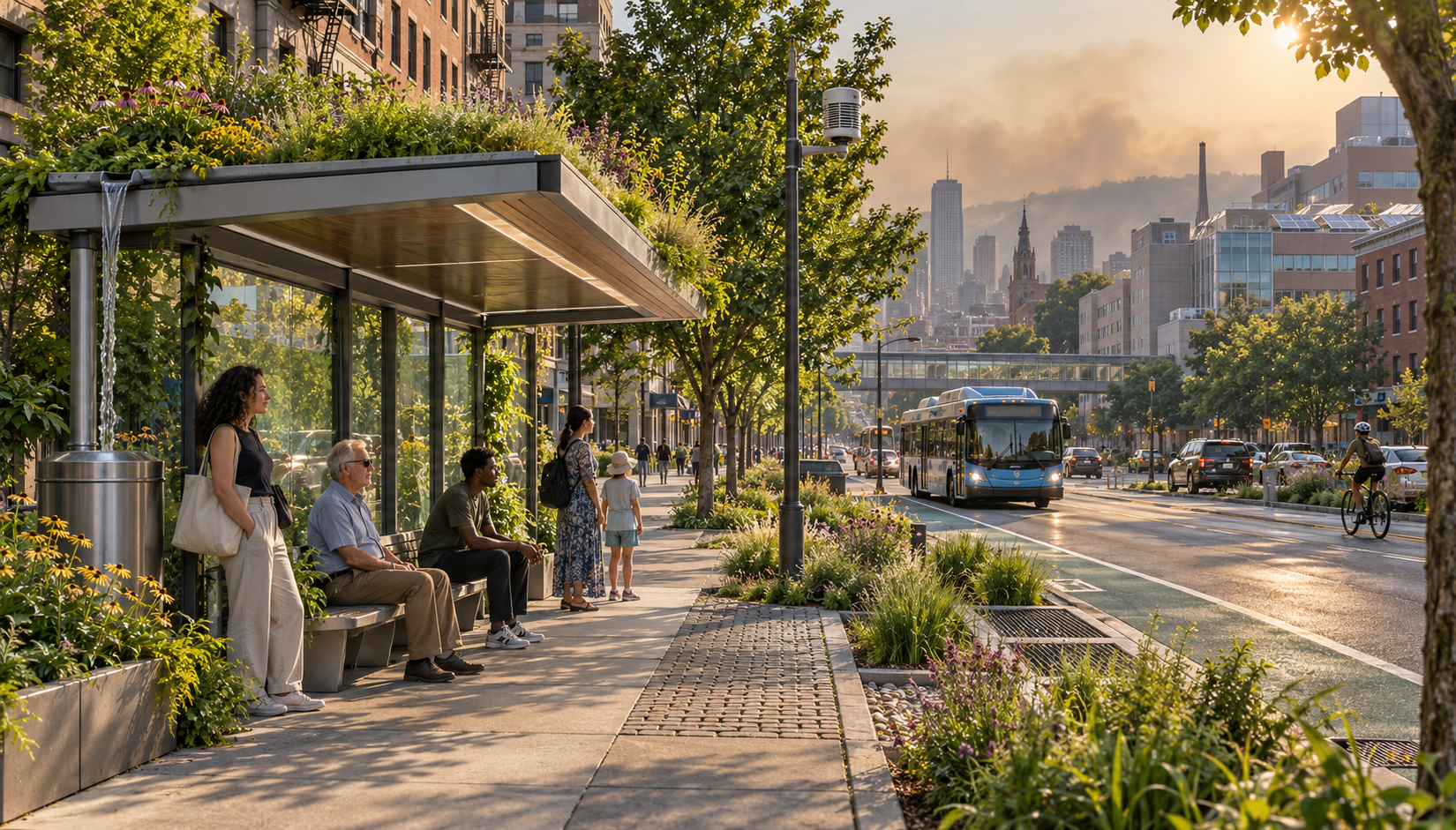
On September 16, New York City introduced four experimental roof structures on bus shelters situated along Pitkin Avenue in Brownsville. The pilot scheme features the city's first green-roof bus shelter, which has native plants growing on it, together with three reflective roofs designed to reduce heat. The initiative also aims at capturing stormwater and dealing with heavy rainfall. [2]
The importance extends beyond the shelter itself, since rather than setting up a separate climate facility the city is investigating whether the infrastructure which people already use can also provide protective functions. (Office, 2026)
GREENCAP INSIGHT
The most practical climate infrastructure may sometimes be the infrastructure people already use, redesigned to protect them better.
3 | Climate and Air Quality Cannot Be Managed Separately
The September 2026 Air Quality and Climate Bulletin from the World Meteorological Organization stresses the close connections between climate change, air pollution, and health, and points out aerosols from wildfires, while calling for better observations of fine particulate matter, ground-level ozone, black carbon and airborne microplastics. [3]
This presents a problem in terms of governance since communities may manage the pollution which they themselves produce but can still suffer from poor air quality caused by smoke or other pollutants that are transported over long distances. (Transboundary Air Pollution, 2011)
GREENCAP INSIGHT
Clean local air increasingly depends on environmental conditions far beyond local borders.
The approach to climate policy for power plants in the United States has changed direction.
On September 14, the U.S. Environmental Protection Agency finalized a partial repeal of the 2024 carbon-pollution standards for fossil-fuel power plants and proposed rescinding the remaining greenhouse-gas standards for the power sector. EPA estimates the finalized action will save $310 billion and frames the change around reliability and affordability. [4][5]
The policy remains contested. The central public-interest question is how energy policy should weigh reliability, affordability, emissions reduction, and public health when each can affect community resilience. (Trade-offs in justice-oriented grid expansions, 2026)
GREENCAP INSIGHT
Energy policy is increasingly climate policy, economic policy, and public-health policy at the same time.
5 | Climate and Health Are Moving Higher on the Global Health Agenda
For the 81st United Nations General Assembly, which takes place from 18 to 28 September, the World Health Organization has named climate and health, sustainable health financing, global health security, emergency preparedness, and resilient health systems as its priorities. The organisation states that the present situation is one influenced by climate-related threats, health emergencies, and economic pressure. (WHO launches 2026 appeal to help millions of people in health emergencies and crisis settings, 2026) [6]
GREENCAP INSIGHT
Climate resilience becomes durable when it moves from a temporary initiative into the normal responsibilities of institutions.
Scientific & Policy Outlook
From Climate Projects to Climate Systems
For years, adaptation has often been expressed through individual projects: a cooling center, flood barrier, emergency plan, or tree-planting program. Those interventions remain important. But this week’s signals suggest a more integrated model: transportation infrastructure that provides heat protection; air-quality systems that account for climate-driven smoke; health institutions preparing for climate threats; and energy policy being debated through reliability, cost, emissions, and health. (O’Donnell & Sovacool, 2026)
This is the beginning of climate-informed systems design. The objective is not to make every public asset a climate project. It asks whether ordinary infrastructure can keep performing its essential function under changing conditions and whether modest redesign can create additional public value.
Community Resilience Spotlight | Brownsville, Brooklyn
Brownsville’s bus-shelter pilot offers a small but highly visible example of integrated resilience. The project combines mobility, heat protection, stormwater management, nature, and neighborhood experience in infrastructure residents already encounter every day. The city is working with Resilient Cities Catalyst and the Pitkin Avenue Business Improvement District and plans to use community feedback and performance data to assess what might be scalable. (Mayor Mamdani Announces New York City’s First Bus Shelter With a Cooling Green Roof in Brownsville, 2026) [2]
Resilience should not always require people to go somewhere special. Sometimes resilience should meet people where they already are.
Key Takeaways
- The U.S. climate baseline is shifting: summer 2026 was the warmest on record for the contiguous United States.
- Adaptation is now being incorporated into ordinary infrastructure rather than being considered merely as a response to emergencies. (Gould et al., 2026, pp. 471-479)
- Climate and air quality are linked across geographic boundaries, making it difficult to protect public health at the local level.
- The policy in the power sector shows how difficult it is to balance reliability, affordability, emissions, and health.
- Global health institutions are treating climate resilience as part of mainstream health-system preparedness.
Looking Ahead
The records provide evidence, but the reaction tells the bigger story. When judging the next generation of climate resilience, attention will be given to whether ordinary systems, such as transportation, housing, energy, health care, public space, and information continue to be useful and protective as environmental conditions change.
Climate intelligence shows us how conditions are changing while civic intelligence considers what our institutions should do in response to that knowledge.
References
[1] The National Centers for Environmental Information of NOAA. (9 September 2026). Monitoring the temperature and precipitation in the United States in August 2026. https://www.ncei.noaa.gov/news/national-climate-202608
[2] NYC.gov, Office of the Mayor of New York City (16 September 2026). Mayor Mamdani announces New York City's first bus shelter with a cooling green roof in Brownsville.
[3] The World Meteorological Organization, 7 September 2026. WMO Air Quality and Climate Bulletin No. 6, September 2026.
[4] The U.S. Environmental Protection Agency, 14 September 2026. Greenhouse Gas Standards and Guidelines for Fossil Fuel-Fired Power Plants.
The U.S. Environmental Protection Agency (2026, September 14) finalizes the repeal of the 2024 power plant regulations, resulting in savings of more than $300 billion, and suggests repealing all remaining greenhouse gas emissions standards for power plants.
[6] The World Health Organization (2026). World Health Organization at the United Nations General Assembly on 18–28 September 2026.
Editorial Statement
GreenCap Civic Intelligence converts reliable research, public information, data, and knowledge from the community into practical intelligence in order to aid in better public decisions. This Brief is intended as a tool for public education and to promote civic understanding. It does not give any medical advice nor does it endorse any political parties or candidates.
GREENCAP CIVIC INTELLIGENCE INSTITUTE
Better Communities Begin with Better Intelligence.