GREENCAP CIVIV INTELLIGENCE Monday, August 17, 2026
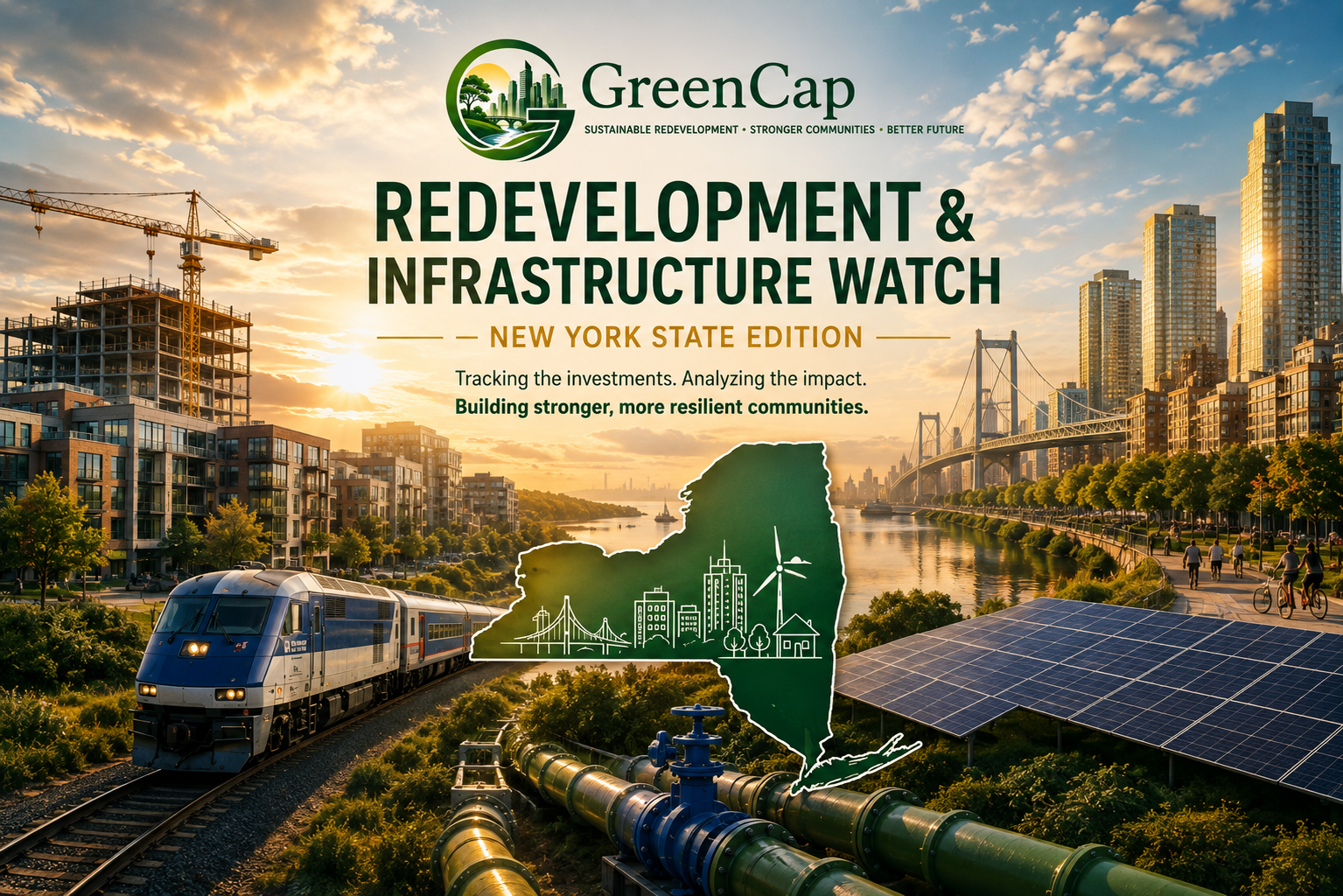
How transportation, housing, clean mobility, and advanced manufacturing connect investment to opportunity. Redevelopment is often measured by what gets built. But the deeper question is whether new investment expands access to opportunity. This week's Watch follows that question across New York. Utica is rebuilding a major gateway around safer multimodal access. Dunkirk is turning underused sites into affordable housing with supportive services. Mount Vernon is adding transit-oriented homes beside Metro-North. New York is expanding public EV-charging infrastructure, while Western New York is strengthening advanced-manufacturing capacity. Together, these developments point toward a broader standard: strong redevelopment connects land to infrastructure, housing to mobility, industry to talent, and investment to public value. Our editorial promise: clear enough for everyone, credible enough for professionals, and actionable for decision-makers.Green-cap
Redevelopment is often measured by what gets built. But the deeper question is whether new investment expands access to opportunity.
This week's Watch follows that question across New York. Utica is rebuilding a major gateway around safer multimodal access. Dunkirk is turning underused sites into affordable housing with supportive services. Mount Vernon is adding transit-oriented homes beside Metro-North. New York is expanding public EV-charging infrastructure, while Western New York is strengthening advanced-manufacturing capacity.
Together, these developments point toward a broader standard: strong redevelopment connects land to infrastructure, housing to mobility, industry to talent, and investment to public value.
Our editorial promise: clear enough for everyone, credible enough for professionals, and actionable for decision-makers.
This Week's Redevelopment Signals
As part of its connection initiative, Utica is reconstructing a gateway.
The renovation of North Genesee Street in Utica, costing $62 million, includes replacing the 61-year-old bridges spanning the Mohawk River and the Erie Canal.
The improvements include adding 10-foot shared-use paths on both sides of North Genesee Street between Wurz Avenue and the interchange with the New York State Thruway, as well as enhancing connections between downtown Utica, the Empire State Trail, local neighborhoods, and regional transportation routes.
Transportation infrastructure goes beyond travel time; it determines whether people can get to work and access services, whether businesses can reach their markets, and whether neighborhoods remain connected to important civic and recreational places.
GreenCap Insight says transportation should create opportunities, not just move vehicles. Utica's corridor project is an example of how infrastructure can also support broader redevelopment.
The film uses land that had been underused to build housing and support the community.
Work has started on the Homesteads at Dunkirk Landing, a housing development costing $37 million that will offer 78 apartments across two sites.
The developments include 16 supportive homes for veterans who have experienced homelessness, along with childcare facilities, all-electric buildings, solar panels, EV charging stations, and accessibility measures; the sites are located in areas included in the downtown revitalization and brownfield redevelopment programs.
Redevelopment is at its most valuable when a single investment addresses a number of the community's needs, since stable housing, childcare, clean energy, accessibility, and neighborhood renewal all contribute to making communities stronger.
GreenCap Insight points out that the most successful redevelopment projects achieve more than simply eliminating blight; they integrate new buildings with a range of services and systems that help the residents take advantage of the changes.
3. Mount Vernon provides affordable housing in close proximity to public transit.
Work on the QWest Towers is now in progress. The project, which costs $160 million, will offer 229 affordable homes next to the Mount Vernon West Metro-North station.
The project has replaced the empty and poorly maintained buildings with two mixed-use, all-electric buildings as well as commercial space; the site now places the residents close to regional rail service and employment opportunities.
Accessibility involves more than just housing affordability; the location where homes are built has an impact on transportation costs, commute times, access to jobs, and the opportunities available to families.
According to GreenCap Insight, building homes in areas with good public transit can make homes both affordable and accessible; homes near reliable transportation enable more people to reach jobs and opportunities through housing investments.
4. A total of 35 million is being used to extend the public infrastructure for electric mobility.
Signal New York has obtained $35 million in financing so public-sector organizations can install and operate publicly accessible Level 2 electric vehicle chargers.
The amendment enables qualified public organizations to carry out large-scale charging projects on publicly owned property, with grants ranging from $1 million to $15 million and applications due by October 20 2026.
The key point is that new technology relies on existing infrastructure; electric vehicles would not suit most people if charging stations are hard to find or only available on a private basis.
GreenCap Insight states that public properties can form part of a clean-mobility network, so that libraries, campuses, city buildings, parks and other public spaces can help make clean energy accessible to all.
The fact that Moog's facility is worth $150 million shows how important industrial ecosystems are.
To celebrate its 75th anniversary, Moog Inc. has opened an advanced integrated manufacturing plant in Erie County worth $150 million.
The change includes the new facility, which boosts advanced-manufacturing capacity in Western New York and reinforces the region's aerospace and high-technology industrial base.
It matters because large industrial investments never occur by themselves; they require skilled workers, energy, transportation, suppliers, research, housing, and land prepared for development. Since industrial competitiveness is a problem for the whole ecosystem, areas that link infrastructure, workforce, research, suppliers, and local quality are better positioned to turn major facilities into sustainable regional growth.
Capital Region Relevance
The Capital Region already possesses a great many of the assets mentioned in the statewide examples published this week, including highways and rail systems, universities and research institutions, industrial land, historic buildings, waterfront areas, and a skilled workforce.
The key issue is whether these assets are well linked. A site intended for redevelopment may have the land but lack adequate utilities. New housing could end up far from where people work. Although research might result in innovation, there may be no nearby space to turn ideas into products. Industrial growth might proceed faster than the local workforce or transport system can support.
To overcome these gaps, civic leaders can take a number of measures. They should establish partnerships among the government, businesses, and community groups to plan projects that address a variety of needs. By conducting regular infrastructure inspections, they can identify potential shortcomings or problems before they slow redevelopment. It is also possible to set up working groups of representatives from utilities, housing authorities, employers, and transportation planners to help develop solutions acceptable to everyone. Furthermore, asking the public for their views on connectivity can reveal new ways to improve it. These steps can help ensure that all assets work together and that the region can achieve its full potential.
When assessing whether Albany, Troy, Schenectady, Rensselaer, Cohoes, Watervliet, and the surrounding areas are ready for redevelopment, connectivity should be considered a basic standard.
Infrastructure Spotlight
Access Is Infrastructure
Access is often viewed as a social issue, but it is also closely tied to infrastructure. The condition of roads and public transport affects how easily people can get to work. Where homes are located influences how much families spend on transportation. Charging networks determine who can use clean mobility options. In the same way, industrial systems shape whether local talent can find new jobs.
A project becomes more valuable when it creates strong connections, rather than standing alone.
Redevelopment Trend of the Week
From Individual Projects to Connected Systems
The main trend is a shift towards multi-purpose development. In Utica, the corridor project is renewing the bridges and including walking and cycling paths. Dunkirk combines housing with services and clean energy. In Mount Vernon, affordable housing is situated next to the rail. Funding for electric vehicles links up public spaces with clean mobility. The expansion of Moog shows the value of a strong industrial network.
If communities take part in planning these systems, redevelopment can generate lasting value that benefits more people.
Green Cap Strategy Note
Connectivity Is a Form of Redevelopment Readiness
A community genuinely prepared for redevelopment should be able to link land with infrastructure, housing with jobs, neighborhoods with transport, research with industry, investment with public benefit, and economic growth with the local population. When considering a major site or project, communities must ask not only whether development is feasible but also whether residents, workers, businesses, utilities, and institutions can connect with it effectively. Civic leaders can conduct these evaluations using frameworks that examine various aspects of connectivity. For instance, a site assessment could involve: its proximity to public transportation and major roads; access to essential utilities and broadband; walkability and accessibility for all users; integration with existing housing, employment centers, and community services; compatibility with regional transit and infrastructure plans; and the possibility of achieving environmental sustainability. Using these criteria can help decision-makers determine which projects are most likely to deliver connected, inclusive, and enduring benefits.
Key Takeaway
It's not just a question of how much a community builds, but rather how effective new investment is in improving access to opportunities.
This week's signals indicate that infrastructure, housing, mobility, and industrial development can produce more public value when they operate as interconnected systems. The most successful communities will not simply attract investment but create the connections that turn investment into sustainable opportunities.
Looking Ahead
GreenCap will monitor how New York combines redevelopment with transportation, affordable housing, clean mobility, advanced manufacturing, workforce capacity, and community benefit. We invite civic leaders, planners, and community members to share examples of local initiatives, questions, or emerging needs. Your feedback will help us identify both the difficulties and the successes seen throughout the state. It will also help enhance GreenCap's position as a collaborative resource for communities.
Concerning the Capital Region, one question deserves special consideration: which underused sites link to the infrastructure, people, institutions, and markets required to enable their next phase?
Selected References
Office of Governor Kathy Hochul. "Governor Hochul Announces Start of Transformative $62 Million Project on North Genesee Street in Utica." August 13, 2026.
Office of Governor Kathy Hochul. "Governor Hochul Announces Start of Construction on 78-Unit Affordable Housing Development in Chautauqua County." August 13, 2026.
Office of Governor Kathy Hochul. "Governor Hochul Announces Construction Underway on 229-Unit Affordable Housing Development in Mount Vernon." August 11, 2026.
Office of Governor Kathy Hochul. "Governor Hochul Announces $35 Million Now Available for Public Sector Entities to Install and Operate EV Chargers." August 14, 2026.
Office of Governor Kathy Hochul. "Governor Hochul marks the 75th anniversary of Moog Inc. and announces its $150 million investment in a new advanced integrated manufacturing facility." August 16, 2026.
GreenCap Editorial Statement
GreenCap Redevelopment & Infrastructure Watch provides independent civic intelligence on the projects, policies, investments, and systems shaping communities in New York.
We aim to communicate information about redevelopment in a way that is easy for everyone to understand, acceptable to professionals, and of practical value to decision-makers.
We go beyond reporting on redevelopment by explaining why it is important.
Every place has potential. Every community deserves opportunity. Every generation has a responsibility to build a better future.
BUILDING FORWARD. TOGETHER.